I just spent 2 hours debating and testing and arguing in circles and bitching about library catalogs with two colleagues and I just want to say
AO3’s website is really, really, really impressive, functional and ergonomic and cohesive. the tag system is INCREDIBLE and AMAZINGLY maintained. this is my professional librarian appraisal.
I’ve found 1 library catalog that meets my standards. even the national library of France’s catalog is shitty in comparison to ao3.
praise.
It’s awesome! As a total ignorant, can I ask what AO3 does and library catalogs don’t?
i might actually type out a longer answer but what it really boils down to is: YOU ACTUALLY FIND WHAT YOU’RE LOOKING FOR
ok so here’s the long unreadable (and probs uninteresting to anyone else than me) version:
– the site design and overall look. it’s easy to read, easy to navigate, and easy to notice what you can click on. Makes good use of fonts and text sizes and styles to make important things stand out and be easily found at a glance, and is just overall very readable. The icons with hovertext! The tags! the amount of info that’s readable at a single glance and actually fits on the same page!
this is BASIC STUFF and it is not a given on a LOT of professional library websites i run into regularly and that drives me INSANE. (Mostly bc one of the very popular, cheap, and easy French-language library catalog softwares has a default online catalog design that sucks and which librarians generally don’t tinker with much.)
– again this seems obvious, but the filters when you’re inside a fandom/tag are SO VISIBLE and SO EXPLICIT. The filters menu makes it instantly clear what it’s for, is easy to navigate and understand and use, intelligently suggests the most popular tags first (which also immediately gives you a lot of information).
My library’s online catalog (which uses the default website set-up I mentioned above) has exactly the same thing, but stupidly executed, unreadable and incomprehensible, and somehow completely unnoticeable despite being exactly in the same place on the page. The site design makes very bad use of the space on the page and basically you just don’t even look over there because it’s so far away from where the rest of the information is and it simply never catches your eye, and even when it does, the vocabulary used is so obtuse you don’t realize what it’s for.
IT’S SO… STUPID AND EASILY FIXABLE… but apparently no public library in the french language can afford a website designer, or they’re all horrifyingly bad
– and finally: THE TAGS. One of the biggest issues we have in catalogs is that people use different words for the same thing. In order for you to find books relevant to your search, we have to apply topic keywords to them (basically: tags), but of course there are Norms so that all libraries, or at least all employees in the same library, use the same keywords. Except despite the norm that still doesn’t happen. I don’t know how it goes in the English-language world but for French language it’s all horribly complicated and surprisingly non-functional, despite how easy it seems in theory, and leads me to complain about the Bibliothèque Nationale de France about once a week at least.
Easy example that I’ve complained about today (for the 6th time this year): ADHD. The term used by the BNF, that we are supposed to use, is “Trouble de l’hyperactivité avec déficit de l’attention” (“hyperactivity disorder with attention deficit”). That’s… not only outdated but flat-out inaccurate (according to French’s current stance on it) — the term people actually use nowadays is the opposite way around, “trouble de l’attention avec ou sans hyperactivité” ( “ADD with or without hyperactivity”), commonly abbreviated to “TDA/H”. The BNF’s system does accommodate for various synonyms, but it appears unaware of this one, so if you search “TDA/H” in the keywords, you won’t find anything. You’d have to look in the title, and if none of our books have it in their title, you’ll find nothing at all, and won’t even be redirected anywhere if we strictly follow the BNF system. (WHAT IS THE POINT OF KEYWORDS THEN, one might ask.)
Tl;dr: you look for the word you and most people actually informed about a topic use, and find nothing at all because some rando has decided that’s not the word you should be using. (Unsurprisingly, this problem pops up a looot for keywords related to minorities, mental illnesses and LGBT+ topics.)
It’s like if you tried to search a site for “fluff” and didn’t find anything because the site has decided to continue using “WAFF” instead. Also, the site has decided that hurt-comfort and guro fic are the same thing, makes no distinction between levels of romance and eroticism so there’s no way to tell cute handholding from smut, and believes that the word “furry” means they get a dog.
=> The system of letting people use their words and linking them — making them synonyms — with what other people have used for the same meaning completely blows my mind. I am in awe of the fact that it works, and that it’s still happening, even though iirc tag-wranglers are unpaid volunteers. I couldn’t imagine doing something like that in just our catalog, and AO3 is massive.
The result is: not only do you find what you’re looking for, but if your search accidentally picks up other things too, you know what it’s actually about because you get it in the author’s words.
AO3′s tag system is an incredibly clever and simple solution to a very real and thorny problem that I run into almost every day.
tl;dr AO3 is just generally a perfectly functional and user-friendly site, instantly easy to use in order to tailor your search to exactly what you want (and even more so with the addition of the exclusion operator to the filters sidebar), and on a technical library-science viewpoint, it’s fascinating.
This is taking me back to when AO3 was first born, and I was having a conversation with someone (@icarusancalion, I think?) about how I didn’t think the tagging system was ever really gonna be useful.
I knew the kind of top-down tagging system that libraries use was often useless for the same reasons you’re describing here: academics like the idea of a priori systems and exclusive classification schemata, but AO3 tagging is useful precisely because tags can be messy and overlapping rather than strict hierarchies. You’ll never get all fandoms everywhere to agree on a common tag family, I said c. 2008. It’ll be outdated before it’s even implemented. But relying entirely on user-generated tags will be a logistical nightmare, past!Maud also argued, because there would be no way to manage synonyms and near-synonyms and typos that would rapidly bloat the system to uselessness.
Well, 2008!me was right about top-down schemata but wrong about user-submitted tags, thanks almost entirely to the work of the tag wranglers: human curators who take the time to link and nest related tags as they come up, without relying on a pristine (and utterly dysfunctional) a priori system to do so.
Would real-world academic libraries benefit from tag wranglers? Absofuckinglutely, but I really don’t think most of them would ever implement them for the same reason past!me was skeptical of them. Maybe if they were shown how well it works on AO3 (where the wranglers are all volunteers!) they might be persuaded to hire some workstudies or under-employed PhDs to wrangle for them. And then the world would be a better place.
Look, I know you doubt me, I know you always have. And you’re right. I often think of Bag End. I miss my books. And my armchair. And my garden. See, that’s where I belong. That’s home. That’s why I came back, ‘cause you don’t have one. A home. It was taken from you. But I will help you take it back if I can.
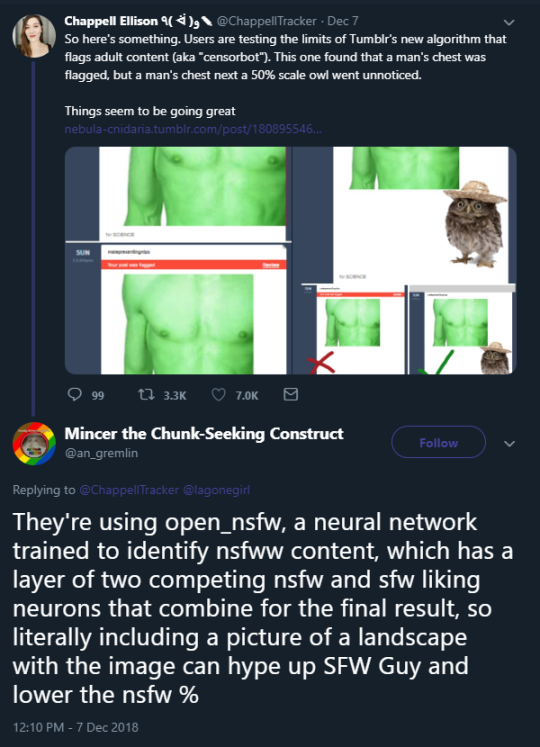
Now, the alarming aspect of this story is that the very same technology is probably what tumblr is using to identify porn. Now, if it can’t tell that an empty field is not, in fact, full of sheep, what hope do we have that it can’t tell an empty room isn’t full of writing human forms engaged in passionate coitus?
this really does sound like an episode of black mirror
This is gonna produce some absolutely baffling pornography.
…. oh my fucking god they actually are using open source software. They’re using a fucking one-layer unidirectional bicategory tag-trained neural network. This will never work. Literally, it will never work. There’s just not enough algorithmic complexity to do what they’re asking of it. I bet you I could prove on a mathematical level that this joke of a neural net fundamentally lacks the abstraction necessary to do its job.
This will never get better. Their algorithm will never stop fucking up, it will never actually flag porn reliably and it will always require a massive quantity of human hours to deal with the deluge of mistagged pictures. This isn’t just a case of an insufficiently trained algorithm, it’s just … this is the most basic neural network you can make. It probably hasa a lot of neurons and has loads of training data but like … you can’t just brute force this kind of stuff. One layer of neurons is just Not Enough.
Also, just to make this clear, Tumblr lied. I mean, we already know this, but I mean they liiiieeeeed. All that stuff they promised about what would or would not be censored? That cannot be delivered on with a system this simple. Nude classical sculptures, political protests, male-presenting nipples (really Tumblr?), nude art outside the context of sex, all that? You cannot train a bicategory one-layer neural network to exclude those things. It cannot be done. Tumblr never intended for those things to actually be permitted, they were just lying. Because the system they have cannot actually do what they said it would and never will be able to.
Also, this kind of system is super vulnerable to counter-neural strategies. I bet you before the end of the month someone hooks up their own open source one layer bicategory neural network which puts an imperceptible (to humans) layer of patterned static over arbitrary images, and trains it by having it bot-post static-ed images to Tumblr and reinforcing based on whether the images are labeled nsfw or sfw. Seriously, within a month someone will have an input-output machine which can turn any image ‘sfw’ in Tumblr’s eyes.
This is genuinely pathetic. Like, I have real pity for whoever implemented this, because it’s clear Tumblr doesn’t actually have any engineers with any expertise with machine learning left at all and they foisted the job off on some poor bastard who has no idea what they’re doing and is going to get all kinds of flak for their (perfectly reasonable and predetermined) failure from management.
As has been pointed out before, there are no humans behind this at all. The review process just reruns either the same algorithm or another algorithm, but people have posted screen shots showing obviously SFW pictures that were still deemed NSFW on review, despite the fact that any human, no matter how overworked / tired would have seen that these pictures were not porn.
People keep asking who would do all the menial jobs if they didn’t have the threat of starvation hanging over their heads, but in my experience there are plenty of people who would be overjoyed to spend all day running minor errands for folks if they were allowed to tell the rude ones to fuck off.
If money wasn’t a problem, I actually enjoy the physical labor of my job and the sense of fulfillment at having something concrete I can look at and accomplish—it’s the being treated like a vending machine/punching bag while also making barely liveable wages that make the whole thing suck, not the work itself
I really enjoyed the tetris like feel of bagging groceries and stocking shelves for years. What wore me down was the inconsistent hours, bad pay, poor treatment of workers overall (they treated the elderly employees especially horribly) and nasty customers who I couldn’t tell off.
For more pay, and more protection, I’d have happily stayed for a while longer.
I absolutely LOVE working early hours making coffee and tea and donuts and all that. I would fucking show up at 4am in the morning to work in a coffee shop that doesn’t have a manager constantly screaming at how long the line is and how many sales we need to make in an hour to reach our quota.
Like, I just really enjoy making food and mornings and people.
Yeah tbh I really like selling phones and helping people understand their technology, I love helping people in general, if malwart wasn’t such a hell hole it’d be perfect
“But who would do all the menial jobs if we didn’t threaten people with starvation?”
Have you considered making them not menial?
1.(of work) not requiring much skill and lacking prestige.“menial factory jobs"synonyms:unskilled, lowly, humble, low-status, inferior, degrading;
The degradation of these jobs and the workers who do them is artificial and deliberate, made to justify the low wages and help reinforce the system that keeps people doing them despite said degradation.
It is entirely possible to create workspaces where the people who do these jobs are treated well, valued, allowed comfort and boundaries. This is a thing we can do.
Vegans of tumblr, listen up. Harvesting agave in the quantities required so you dont have to eat honey is killing mexican long-nosed bats. They feed off the nectar and pollinate the plants. They need the agave. You want to help the environment? Go back to honey. Your liver and thyroid will thank you, as well. Agave is 90% fructose, which can cause a host of issues. Bye.
Beekeeper here! Just wanted to say that the fact that vegans won’t eat honey is very silly. Harvesting honey does not hurt bees. The invention of modern moveable-frame hives means we can remove a selected frame, extract the honey and return it without killing a single bee.
If we destroyed the colony to harvest honey there would be no bees for next year, and beekeepers are incredibly careful to keep their bees healthy and thriving. We take *excess* honey that they don’t need, and it stops the hive from becoming honey-bound, meaning that there’s so much honey the Queen has nowhere to lay eggs. And if the winter is harsher than expected and the remaining honey store runs low, we feed the bees plenty to make sure they survive. We also make sure that pests are controlled, bees are treated for disease, and the hive is weatherproof and in good repair, all things that wild bees struggle with.
Keeping bees in properly managed hives where they don’t starve or die from preventable disease is much better for them than being left to fend for themselves, and they’re far too important to be left alone.
All the fruits and vegetables that vegans *do* eat couldn’t exist without bees, and the hives which pollinate those crops also produce excess honey which the beekeepers can sell to help keep themselves and their hives going.
Not only that, but banks and the rich continuously make bad choices and get bailouts and tax breaks, under the guise that they’re “too big to fail” and it will “negatively impact the economy.” I’m not even saying these banks and corporations make mistakes, they PURPOSEFULLY gamble the system by going out of their way to make bad decisions and they account for this in their profit margins. Poor and middle class Americans taking on debt is barely a choice in this current system, especially for things like education, so brainwashed people in this country can miss me with the “bad decisions” bullshit until banks and corporations are held FULLY ACCOUNTABLE for the bad decisions they make yearly that cost us billions in taxes.







 tumblhoard-paladinkit